
Worlds without End
“The things of God are of deep import; and time and experience, and careful and ponderous and solemn thoughts can only find them out.”1
Joseph Smith
Introduction
Consider what can be seen with telescopes, with natural vision, and with microscopes. There’s a bigger picture into the cosmos, things on the earth, and the minutest of structures. Each level of detail adds context to other levels because knowledge and understanding are nuanced. When some things are plain, other things are obscured.
Details allow zooming in and out to see relationships. A subject on one level appears simpler when viewed further up, and more detailed further in. But not everyone is interested in or ready for every detail. Hence, nourishment with mother’s milk before solid food, or “meat” (1 Corinthians 3:2). Doctrinal “meat” is commonly interpreted as “deep doctrine” or “the mysteries,” which could be considered “deep” only when viewed from a level further up. From a simpler view, additional details can cause things that are “known” to be true to become only partially true. For instance:
From the level furthest up, God created the earth and everything thereon with preexisting matter (Genesis 1:1). Further in, God created the earth and everything thereon spiritually first, and then the Son of God with others created the earth and everything thereon physically (Moses 3:5; Abraham 3:24, 4:1). Are there levels yet further in? Have any additional details been taught? It would be fruitless to blindly speculate about this or any other matter (pun intended). Rather, with what has been revealed and taught, one can reason, seeking to discern light and truth.
Now, for daily discipleship, doctrinal “milk” matters most. The importance of core doctrines and principles surpasses peripheral doctrinal details. Nevertheless, God has revealed many details about many subjects. What benefits might there be in knowing so much about so many things? Are there not more reasons than practical application?
In the Restoration of the gospel of Jesus Christ through the Prophet2 Joseph Smith, some things have been revealed for the first time (D&C 124:41). Perhaps some of these things concern eternal life. The glories of eternal life are beyond description, and few details have been revealed. As children of Heavenly Parents3, we have the potential to become like them, to live as they live, to do what they do throughout eternity. Those who inherit the celestial kingdom—the exalted, those crowned with eternal life as kings and queens, gods—can progress toward their ultimate potential (D&C 76:50–70, 132:20), which surpasses the potential of those who inherit the terrestrial and telestial kingdoms (D&C 76:77–78, 81).
“What is the object of our coming into existence, then dying and falling away to be here no more? . . . . Could you gaze in heaven five minutes, you would know more than you would by reading all that ever was written on the subject.”4
Joseph Smith
God provides a pattern in all things (D&C 52:14); for instance: agency is fundamental to existence (D&C 93:29–30); blessings depend on obedience (D&C 130:20–21); progression is line upon line (D&C 93:19–20); principles are eternal but their implementation is circumstantial (D&C 84:1–27); the Son of God, the Savior, the Redeemer, is central to the plan of salvation (John 14:6); the plan of salvation consists of pre-mortal, then mortal, and then post-mortal life (Abraham 3:22–26, D&C 76:96–98). The exalted inherit thrones, kingdoms, principalities, powers, dominions, and eternal increase of posterity (D&C 132:19, 63). What might the glories of eternal life and progression in the celestial kingdom comprise? Is there a pattern?
Jesus taught certain things only privately, some of which were recorded and later became public (Matthew 24), while others were private (Mark 4:34), even sacred (Acts 1:1–3, forty-day5 apocrypha). Joseph and Brigham were Apostles of the Lord Jesus Christ. The Restoration is the work of the Lord (2 Nephi 3:24, 3 Nephi 16:27). Joseph is the Prophet of the Restoration (JS—H 1:17, D&C 110:16). Joseph sealed upon Brigham and the Twelve all the keys6 that God had conferred upon him. As a witness and continuer of Joseph’s work, Brigham also considered himself “an Apostle of Joseph Smith.”7
Joseph received far more revelations than he taught. Yet, not all of his revelations that he did teach have been canonized or integrated into official doctrine. At times, Joseph seemed to have also taught his beliefs or opinions. How his beliefs relate to his revelations remains unclear.
Joseph taught certain things only privately8, as did Brigham Young and other prophets. But Brigham taught at least some of what he learned privately from Joseph. Brigham also taught from his own revelations, and perhaps also his beliefs or opinions. How these teachings from Brigham relate to Joseph’s unspoken revelations, privately taught revelations, and his publicly taught beliefs remains unclear.
Uncanonized teachings of prophets that would be at levels further in than canonized scripture have not been thoroughly elucidated, and, therefore, are neither emphasized nor generally accepted. Nevertheless, is there truth to be found in these teachings?
“I suppose that I am not allowed to go into an investigation of anything that is not in the Bible—you would cry treason.”9
Joseph Smith
“I could explain a hundred fold more than I ever have of the glories of the kingdoms manifested to me in the vision [D&C 76], were I permitted, and were the people prepared to receive it.”10
Joseph Smith
“Men will set up stakes and say, ‘Thus far will we go and no farther.’”11
Joseph Smith
“There has been a great difficulty in getting anything into the heads of this generation . . . . I have tried . . . to get the minds of the Saints prepared to receive the things of God, but we frequently see some of them . . . will fly to pieces like glass as soon as anything comes that is contrary to their traditions.”12
Joseph Smith
The power of the Holy Ghost testifies of light and truth. As we continue faithful to the light and truth we receive, we are to receive more and more (D&C 50:24).
Is God limited to revealing or confirming only that which is already known and is canonized? Is not “revelation” that which was not known previously? And is not additional revelation sometimes required to understand a previous revelation?
Teachings of prophets that cannot be clearly connected to scripture one might consider doctrine, another might consider theory, and another might dismiss entirely. Ordinarily, the term doctrine refers generically to a teaching, implying neither true nor false, and the term theory to an idea substantiated by evidence. But relative to the gospel, the term doctrine has come to imply truth, and theory to either false doctrine or an idea or interpretation unsubstantiated by scripture. Consensus of opinion does not define truth but orthodoxy. Regardless of opinions on whether a teaching is true or false, what might we glean from what prophets have taught but that is not emphasized?
Of teachings from Joseph and Brigham that they did not teach publicly, would it not be hubris to dismiss, and from unwise to apostasy to promote? Thus, it is wise to not advocate that which contradicts orthodoxy. Those willing might seek to consider all that has been revealed and taught, exploring possibilities through “careful and ponderous and solemn thoughts,” such as will be lightly touched upon in the following.
Some will perceive this discussion as concerning “meat,” and others, a “strange road” (1 Nephi 8:31–32) or a false doctrine or theory.13 It is for the individual, if desired, to discern what may be revelation or opinion, truth or error. If we err in reception or perception, then we are accountable only to God for it. Whatever we may receive revelation about, we would be wise to trust, believe, and keep sacred. To paraphrase Joseph, “Good doctrine tastes good.”14
“I want the liberty of believing as I please; it feels so good not to be trammeled.”15
Joseph Smith
“I never heard of a man being damned for believing too much but they are damned for unbelief.”16
Joseph Smith
Some Private Teachings
Joseph received many revelations, visions17, and visitations18 by several heavenly beings in different ways and for different purposes. Some of his visions were also given to other participants with him. Angels appeared to him in their glory and also as men on the earth, otherwise unawares to others (Hebrews 13:2).
Joseph taught doctrines that were revealed to him and according to his expanding understanding. Joseph taught with authority—the priesthood authority that God and his patriarchs, prophets, and apostles conferred upon him, as well as the authority of certain knowledge received by revelation. Not all of his revelations were given to be recorded to become scripture or official doctrine. Some of his revelations, or portions thereof, he taught only privately.
Wilford Woodruff19 said, “The fact is, there are a great many things taught in the building up of this kingdom which seem strange to us, being contrary to our traditions, and are calculated to try men. Brother Joseph used a great many methods of testing the integrity of men; and he taught a great many things which, in consequence of tradition, required prayer, faith, and a testimony from the Lord, before they could be believed by many of the Saints. His mind was opened by the visions of the Almighty, and the Lord taught him many things by vision and revelation that were never taught publicly in his days; for the people could not bear the flood of intelligence which God poured into his mind.”20
As a result, some of Joseph’s doctrines may seem to have no clear connection to scripture but skip to levels of detail further in. Before examining these, however, consider his public teachings about Adam:
“The priesthood was first given to Adam. He obtained the First Presidency and held the keys of it from generation to generation. He obtained it in the Creation before the world was formed . . . . He had dominion given him over every living creature. He is Michael the Archangel, spoken of in the scriptures. . . .
“Then to Noah, who is Gabriel. He stands next in authority to Adam in the priesthood. He was called of God to this office and was the father of all living in his day, and to him was given the dominion. . . .
“The keys have to be brought from heaven whenever the gospel is sent. When they are revealed from heaven it is by Adam’s authority.
“Daniel 7 speaks of the Ancient of Days; he means the oldest man, our father Adam, Michael. He will call his children together and hold a council with them to prepare them for the coming of the Son of Man. He (Adam) is the father of the human family and presides over the spirits of all men, and all that have had the keys must stand before him in this grand council . . . . The Son of Man stands before him and there is given him glory and dominion. Adam delivers up his stewardship to Christ, that which was delivered to him as holding the keys of the universe, but retains his standing as head of the human family. . . .
“The Father called all spirits before him at the creation of man and organized them. He (Adam) is the head and was told to multiply. The keys were first given to him, and by him to others; he will have to give an account of his stewardship, and they to him. . . .
“The Savior, Moses, and Elias gave the keys to Peter, James, and John on the Mount when they were transfigured before him. . . .
“How have we come at the priesthood in the last days? It came down, down in regular succession: Peter, James, and John had it given to them, and they gave it to others; Christ is the Great High Priest; Adam next.”21
Joseph Smith
Summary of salient points:
In the Creation, Adam, who is Michael, was the first ordained to the priesthood. He was given, or conferred, the keys of the universe, of dominion over every living creature, and of the First Presidency. Adam authorizes the revealing, or the conferral, of the keys.
As the oldest man, Adam is the Ancient of Days in Daniel 7, the father of the human family, who presides over the spirits of all men.
Each to whom the keys are given, or conferred, will have to give an account of his stewardship. Adam, retaining his standing as head of the human family, will deliver up, or confer, the keys to Christ before his Second Coming.
“I beheld till the thrones were cast down, and the Ancient of Days did sit,
whose garment was white as snow, and the hair of his head like the pure wool,
his throne was like the fiery flame, and his wheels as burning fire. . . .

“And behold, one like the Son of Man came with the clouds of heaven,
and came to the Ancient of Days, and they brought him near before him,

“and there was given him dominion and glory. . . .”

Daniel 7:9, 13–14
A “son of man,” or a son of Adam, man referring to Adam, generally means a mortal. But in Daniel 7, the Son of Man coming to the enthroned Ancient of Days refers to the Messiah coming to God. In the pre-Millennial grand council at Adam-ondi-Ahman (D&C 116), Christ will stand before Adam and receive glory and dominion.
How could Adam have higher authority than Christ? Some of Joseph’s private teachings can provide further insight. Following are some accounts of these teachings:
Helen Mar Kimball Whitney said, “Brigham Young did not happen to be the author of this doctrine,” “that Adam is our Father and our God,” citing Joseph’s sermon on the priesthood being first given to Adam and Daniel 7. “When the Saints first heard this doctrine advanced it looked strange and unnatural to them; it was strong meat and required a little time before it could be digested; but this was owing to the narrow, contracted ideas which had been handed down from generation to generation by our forefathers. . . . When I was able to comprehend it, it appeared quite consistent. There is something in this doctrine that is very home-like, grand and beautiful to reflect upon, and it is very simple and comprehensive.”22
Joseph “explained the meaning of the word ‘Ahman,’ which signifies the first man or first God, and ‘Ahman Christ’ signifies the first man’s son.”23
Joseph, according to Brigham Young from Wilford Woodruff, said, “Adam was Michael the Archangel, and he was the Father of Jesus Christ, and was our God.”24
Orson Pratt said, “[The] doctrine of Adam being our Father, to my personal positive knowledge, that was Joseph’s doctrine and what he believed . . . and what he knew, and he said that every one of us that kept the celestial law would be Adams too. . . . Joseph said hundreds of times he could not reveal that [which was] revealed to him because the people could not believe it and increase and grow as fast as he wanted them; and because God has revealed to him and let him know and understand and brought this church along step by step, [they were] not revealed in Joseph’s day.”25
Joseph, according to Anson Call, said, “Adam came here from another planet an immortalized being, and brought his wife, Eve, with him; and by eating of the fruit of this earth became subject to death and decay, and he became of the earth, earthy [1 Corinthians 15:20], and was made mortal and subject to death.”26
Joseph, according to Lorenzo Snow from Orson F. Whitney, told a man that that man “would become a God and reign in glory, but before that, he would have to be crucified as Christ was.”27
Joseph, according to Wilford Woodruff, publicly taught that “the God and father of our Lord Jesus Christ was once the same as the Son or Holy Ghost; both having redeemed a world became the eternal God of that world; he had a son, Jesus Christ, who redeemed this earth the same as his father had a world, which made them equal; and the Holy Ghost would do the same in his turn, and so would all the Saints who inherited a celestial glory, so there would be ‘Gods many and Lords many’ [1 Corinthians 8:5].”28
Brigham Young said, “Is there in the heaven of heavens a Leader? Yes, and we cannot do without one and that being the case, whoever he is may be called God. Joseph [said] that Adam was our Father and God, and himself, being a leader, he too was their God.”29
These teachings about God, Christ, and Adam, for which Brigham is widely known, are less known to originate with Joseph.
It may seem contradictory for Adam to be higher in authority than Christ, for instance, relative to D&C 78:15–16; however, with one additional adjustment, Joseph appended the last clause of verse 15 and added verse 16 to the revelation:
1832 (Revelation, 1 March 1832)
“that you may come up unto the crown prepared for you and be made rulers over many kingdom[s] saith the Lord God the holy one of Israel”30
1835 (D&C 75:3)
“That you may come up unto the crown prepared for you, and be made rulers over many kingdoms, saith the Lord God, the Holy One of Zion, who hath established the foundations of Adam-ondi-Ahman;
“Who hath appointed Michael your prince, and established his feet, and set him upon high, and given unto him the keys of salvation under the counsel and direction of the Holy One, who is without beginning of days or end of life.”31
Joseph Smith
Joseph learned precept upon precept. His teaching about Adam “in Luke Johnson’s” was likely between 1835 and 1838, and his discourse about Daniel 7 was in 1839. Regardless of when this “strong meat” was revealed to him, Joseph apparently never taught it publicly. And although in 1844 he finally taught a plurality of Gods publicly (in his King Follett discourse32 and his Sermon in the Grove33), he did not accordingly revise the 1844 Doctrine and Covenants. Joseph, as Brigham, tested the Saints precept upon precept.
How are we to understand these teachings about Adam? Can we connect them to canonized scripture, or are they at a level further in?
“When did I ever teach anything wrong from this stand? . . . . I never told you I was perfect—but there is no error in the revelations which I have taught.”34
Joseph Smith
Were Joseph’s teachings about Adam and Christ, and Adam as God revelations, opinions, both? Figuratively35, Adam can be viewed as the father of Jesus just as Abraham can be as the father of the faithful. And as a God, Adam can be viewed as our God as Moses was like a god to Pharaoh (Exodus 7:1). At the very least, Adam is our Father because he presides over the spirits of mankind and the conferral of priesthood keys, and Adam is our God as a leader. Adam is not just a name but is also a title, given to the first man on every earth, and can be symbolic.
Joseph publicly taught that “every man who reigns in celestial glory is a God to his dominions.”36 As such, Joseph’s and Brigham’s uses of “Adam” may not always be about the person Adam but may sometimes be about a class of person—our God, a God, or a god.
For the Holy Ghost to become a God, he would first have to obtain a physical body. Joseph publicly taught that “the Holy Ghost is now in a state of probation, which, if he should perform in righteousness, he may pass through the same or a similar course of things that the Son has,”37 and “the Holy Ghost is yet a spiritual body, and is waiting to take to himself a body as the Savior did or as God did or the gods before them took bodies.”38
What did Joseph mean by being crucified as Christ was? Was this figurative, as each of us must take up our cross (JST Matthew 16:25–26, 3 Nephi 12:30)? Or, was this literal in an unclarified doctrinal context, seemingly contradictory to present understanding of resurrection?
If gods are to become Gods as has the Father, as will Christ, and as will the Holy Ghost, then it would appear that there are missing pieces to the doctrinal puzzle that perhaps Joseph did not teach, were not recorded, or are not available publicly.39
To attempt to address doctrinal gaps, many questions arise, such as, but not limited to: In accounts of Joseph’s teachings, does a capitalized term ever indicate a title either instead of or in addition to a literal meaning? Is “Father” distinct from “father,” and “God” from “god”? Does Joseph’s public teaching that Jesus came “to lay down my life as my Father did, and take it up again” mean that he had the power to give his life and resurrect himself? Or, did he imply other privately held or taught doctrines wherein a male god experiences another mortality as himself but as a Christ? Can gods or Gods lay their bodies down to become mortal again, and then take up their bodies in resurrection? Can gods or Gods receive different callings in future mortalities while maintaining their personalities—a unique form of reincarnation?
Eliza R. Snow, according to Lorenzo Snow from Orson F. Whitney, said she “was a firm believer in the principle of reincarnation and that she received it from Joseph.”40
If Joseph privately taught reincarnation, which would be at a level further in, what might he have meant? Being born more than once, each time in a different body and with a different personality, or as a form of animal life, or as an object, is incompatible with the gospel. However, relative to exaltation, might Joseph have expounded on eternal progression? Are male gods first exalted to an Adam before being exalted to a God—a God the Father, a God the Son, a God the Holy Ghost? How else could a man be crucified as Christ was before that man can become a God?
“I am going to tell you how God came to be God, and what sort of a being He is. . . . The first principle of truth and of the Gospel is to know for a certainty the character of God, and that we may converse with Him the same as one man with another, and that He once was a man like one of us, and that God Himself, the Father of us all, once dwelled on an earth the same as Jesus Christ himself did in the flesh, and like us. . . .
“What did Jesus say? As the Father has power in Himself, even so has the Son power in Himself. To do what? Why, what the Father did. . . . to lay down his body and take it up again. . . .
“You have got to learn how to make yourselves Gods . . . and be kings and priests to God, the same as all Gods have done—by going from a small capacity to a great capacity, from a small degree to another, from grace to grace, until the resurrection of the dead, from exaltation to exaltation—till you are able to sit in everlasting burnings and everlasting power and glory, as those who have gone before sit enthroned. . . . to . . . be heirs of God and joint-heirs with Jesus Christ . . . to inherit and enjoy the same glory, powers, and exaltation until you ascend a throne of eternal power and arrive at the station of a God. . . .
“What did Jesus Christ do? ‘Why, I do the same things that I saw my Father do when worlds came rolling into existence.’ Saw the Father do what? ‘I saw the Father work out His kingdom with fear and trembling, and I am doing the same, too. When I get my kingdom, I will give it to the Father, and it will add to and exalt His glory. He will take a higher exaltation, and I will take His place and am also exalted, so that He obtains kingdom rolling upon kingdom.’ So that Jesus treads in His tracks as He had gone before, and then inherits what God did before. God is glorified in the salvation and exaltation of his creatures. . . .
“When you climb a ladder, you must begin at the bottom rung. You have got to find the beginning of the history and go on until you have learned the last principle of the Gospel. It will be a great while after the grave before you learn to understand the last, for it is a great thing to learn salvation beyond the grave, and it is not all to be comprehended in this world.
“I suppose I am not allowed to go into an investigation of anything that is not contained in the Bible. If I should, you would cry treason. . . .”41
Joseph Smith
Is “going from one small degree to another” eternal progression? If exaltation is not a final state but another beginning, for gods to gradually “learn all the principles of exaltation,” then what constitutes stations obtained “from exaltation to exaltation . . . . until [a god arrives] at the station of a God”?
Some of what Joseph taught privately, Brigham also taught privately but also publicly for the last approximately twenty-five years of his life. Through revelation and perhaps also opinion, Brigham taught with expanding understanding and clarity but not without ambiguity. Due to continued confusion, unbelief, and contention among the Saints about these teachings, they were gradually withdrawn.42
Orson Hyde shared a principle Joseph taught that describes how revelation was to be handled by the presiding quorums of the Church: “There is a way by which all revelations purporting to be from God through any man can be tested. Brother Joseph gave us the plan. Says he, when all the quorums are assembled and organized in order, let the revelation be presented to the quorums. If it pass one, let it go to another; and if it pass that, to another; and so on until it has passed all the quorums; and if it pass the whole without running against a snag, you may know it is of God. But if it runs against a snag, then, says he, it wants enquiring into: You must see to it. . . . let no revelation go to the people until it has been tested here.”43
This process has continued in some form. The presiding quorums determine how the Church will handle every revelation. Revelations that “pass” to become official doctrine are likely to be at the level of detail of canonized scripture and be primary sources. The selectivity of official doctrine from among all revelations to all past and present prophets is understandable, expected, and wise.
“I will give you a key that will never rust: If you will stay with the majority of the Twelve Apostles and the records of the Church, you will never be led astray.”44
Joseph Smith
Joseph’s counsel to follow the majority of the brethren, the records of the Church, and the Saints concerned the place to gather. The majority followed Brigham45 to the Rocky Mountains, which Joseph46 said would happen. There is no authority in a minority or in a lone voice. And would not the maintaining of things exactly as Joseph left them take the “living” out of the “true and living church” (D&C 1:30)?
A living prophet is more important than a dead prophet but only in that a living prophet rightfully addresses current conditions. Although understanding of doctrines and principles may expand and policies may change, a living prophet cannot rightfully contradict truth taught by any other prophet. Nevertheless, the Church is governed by revelation to the president of the Church and unanimity among the presiding quorums (D&C 107:22–24, 27).
In considering recorded teachings, whether first-hand, by a scribe, or attributed, reliability is a factor. The reliability of an account decreases as time since the event and the number of relays in “the telephone game” increase. The conditions met in the recording of dialogue and events are not always ideal. A record may be second- or third-hand, a late remembrance, or simply be mistaken in details. While some degree of misrepresentation is possible, having multiple, contemporary witnesses with integrity increases confidence in reliability. Discretion is required of the reader, and charity is deserved of the author.
It may remain unclear whether a statement is revelation or opinion, and the doctrinal significance of a revelation can vary greatly. Nevertheless, are not all revelations and teachings47 from the Prophet Joseph, as well as from his successors, worth consideration?
For every doctrine, principle, and teaching, is it not also for each of us to solemnly consider for ourselves? And if there becomes a “snag” in us, then would not God want us to enquire into it, to pray about and work out with Him how we are to handle it for ourselves? Nevertheless, if we receive the words of the prophets as if from God, in all patience and faith, blessings are promised (D&C 21:4–6); otherwise, we become a law unto ourselves (Romans 2:14).
While there is no need to trouble ourselves over “the mysteries,” the following is for those willing to begin to further explore some of Joseph’s available private teachings—to attempt to tentatively fill in the doctrinal puzzle—without “the picture on the box.”
This Earth
Even in premortality, the Atonement of Christ was effectual. The spiritual blessings of exercising faith in Christ’s suffering for sin and death are the same whether he would or he did—whether before or after the events during his mortality that established him as “the faithful witness” (Revelation 1:5). Without the Atonement, there would be no mortality. And without mortality, there would be neither need of nor opportunity for the Atonement.
This earth was created48 for the next step in the eternal progression of spirit children—mortality. Mortality is marked by spiritual death, or separation from God, and physical death, or the separation of spirit from body.
Before Adam and Eve entered the Garden of Eden, plant life and animal life were in process of fulfilling the measure of their creation. Physical death before the Fall is indicated by the yielding of fruit and seed and the eating of plant life, as well as by Joseph Smith having identified certain stones at Adam-ondi-Ahman as part of the altar on which Adam offered sacrifices49 and James E. Talmage having identified these stones as fossiliferous.50
The events in the Garden of Eden, through which “Adam fell that men might be” (2 Nephi 2:25), brought spiritual death and physical death to Adam and Eve, and spiritual death to the earth.51 The state of the earth fell from paradisiacal, or terrestrial, to telestial. The Fall allowed mankind to be, as “men are that they might have joy” (2 Nephi 2:25). When inseparably connected, or immortal, the spirit and body receive a fulness of joy (D&C 93:33). Without the Fall and the Atonement, there would be no mortality, no immortality, and no fulness of joy—no becoming like our Heavenly Parents.
Our Heavenly Parents bore and raised each of us, their spirit children, in our pre-mortality. There, we exercised faith in the Son of God, which enabled us to progress to mortality, a telestial world, this earth (“You are here”). The spirit world is also here. Through birth into mortality, a physical body is added upon the spirit body (Abraham 3:26). Adam and Eve are our first parents (Alma 42:2). The gospel was taught from the beginning (Moses 5:58–59).
The Son of God fulfilled his mortal mission on this earth, the earth that was inhabited by those wicked enough to assent to the death of their promised Savior (Moses 7:36). Here, our Savior wrought the infinite Atonement, willingly suffering sin and death for all (D&C 19:15–19), laying down his life and taking it up again in resurrection (3 Nephi 9:22). His sacrifice enables our redemption through obedience to the laws of the gospel (D&C 14:7, 19:16).
During the Millennium, this earth will be terrestrial, or paradisiacal, in some ways comparable to Eden before the Fall (Articles of Faith 10). Among the living and the dead, everyone is to have an opportunity to hear and accept the fulness of the gospel (D&C 133:37; 138:36–37, 58).
When the Savior’s work is done52 on this earth, it will be made like unto crystal, a great Urim and Thummim (D&C 130:9), a sea of glass (D&C 77:1), a celestial kingdom (D&C 88:17–20). As joint-heirs with the Son of God (Romans 8:17), the exalted inherit all that their Father has (D&C 84:38).
One Eternal Round
Is an eternity53 one eternal round? From pre-mortality to pre-mortality—from the pre-mortality of one generation of spirit children through their mortality, resurrection, and the pre-mortality of the posterity of their exalted—has been termed one eternal round.
Heavenly parents are resurrected. They were previously mortal, faithful, and crowned with exaltation. They became gods with their God.
Other of our spirit siblings have lived, do live, and will yet live on innumerable worlds. Each world has an Adam and Eve, for of each there are many (Moses 1:34, 4:26). Thus, each world has a Fall and is redeemed through the Son of God. The gospel is taught by angels who belong to each earth (D&C 130:5) and by prophets among their noble and great ones (Abraham 3:22). The Son of God ministers to every earth that he creates under the direction of the Father (D&C 88:41–61).
Each earth that rolls into existence, after it fulfills the measure of its creation, is to become a kingdom of glory.
Is the potential of each earth a celestial kingdom, or one of the three kingdoms of glory?
Is each kingdom of glory in our visible cosmos, or in a different but related “space” (D&C 88:37)—or dimension, for lack of a better term; as the spirit world is in a different “space,” while also being here?
Can a world fail to fulfill the measure of its creation?
Are any worlds broken up, previously organized matter being disorganized, to become materials (Abraham 3:24) to be used in the creation of other worlds?
Are any worlds created for purposes other than for the immortality and eternal life of man?
Are any worlds created in which their culmination is to be inhabited by life forms that are not our spirit siblings?
Eternal Rounds
The Father receives a higher glory through his children who return to his presence to receive all that he has. His exalted children who return to him become gods.
Is bearing spirit children the pinnacle of godhood? Or, does godhood include eternal progression through higher callings, stewardships, stations, priesthood offices?
Are gods distinct from Gods? If so, do gods become Gods?
Do gods or Gods create and oversee the plan of salvation effected on innumerable earths?
Do gods bear spirit children for their God to oversee through mortality and salvation? Or, do gods progress to become Gods to oversee the mortality and salvation of their own spirit children?
Adam and Eve
The Edenic, pre-Fall world of Adam and Eve is terrestrial.
Adam, a son of God, is formed of God (Luke 3:38, JST Luke 3:38).
Are Adam and Eve54 chosen from (1) spirit children, or (2) gods?:
1. Are Adam and Eve born and raised55 in Eden? Do they commence mortality for their spirit siblings?
2. Or, as gods bear the souls of men (D&C 132:63), are souls synonymous with spirits? Or, as the spirit and the body are the soul of man (D&C 88:15), do they work out their salvation on another world? Do they enter the Garden of Eden in their immortal, celestial glory as gods? With all things theirs, including life and death, in partaking of the forbidden fruit, do they temporarily lose their glory? Is the spirit that had flowed in their veins replaced by blood, temporarily separating themselves from the fulness of joy they had received in resurrection? Do they commence mortality for their own spirit children? Upon their physical death, do they return to the celestial kingdom? As the Son of God was chosen in the Grand Council56, are Adam and Eve similarly foreordained callings?
The Father and The Son
The Father was a Savior on another world. The Son of God followed in the footsteps of his Father and his God, our Father and our God (John 20:17).
When this earth becomes a celestial kingdom, it will become the Son’s, and the Father will take a higher glory, in which his light will increase through his children who return to his presence.
Does only one spirit son of the Father become a Savior during mortality? Or, can all spirit sons become a Savior in future mortalities? As a god, does a son first become an Adam, then a Son of God, and then a God the Father? Was the Father an Adam prior to being a Savior? And if so, prior to being an Adam, was the Father as the rest of us in mortality?
The Son of God
As the rest of us, the Son of God is born into mortality on a telestial world. He has power over life and death, choosing when, on what, and on whom to exercise this power, including on himself. As a God, he voluntarily suffers the spiritual and physical pains for the sins of all, and then the pains of physical and spiritual death, as none could take his life, and then willingly gives up the ghost, commending his spirit to the Father.
Marriage is required to lawfully sire. Each of us is a child of Heavenly Parents. The Son of God is the only son who the Father, in some way, sires in the telestial world. In the conception of the Only Begotten, the mother of the Son of God is overshadowed by the power of the Most High, or of the Father.
In the conception of the Son of God, does the power of the Father manifest through (1) a divine process not requiring marriage, or (2) through natural means requiring marriage?:
1. As God can do all things in his power, can the mother of the Son of God be married for time and sealed for eternity to her mortal husband?
2. Is overshadowing transfiguration? Is the mother of the Only Begotten sealed57 to the Father and married only for time to her mortal husband? If the Father is Adam, does Adam receive a plural wife from among his spirit daughters for her to lawfully become the mother of the Only Begotten?
Conclusion
From plain to paradoxical, the revelations and teachings of the Prophet Joseph Smith can clarify in an instant or challenge for a lifetime. One can only wonder what revelations Joseph kept private that would have caused him to conclude that, if he would have divulged, “There is scarce a man that would stay with me—they could not bear it,”58 and not merely cause Brigham to apostatize but the Twelve to kill him.59
Joseph’s private teachings about Adam that were ostensibly later taught and expounded publicly by Brigham can be understood to apply to the Father.60 But Joseph unequivocally taught things about Adam, including that which is even claimed to be in unpublished Jewish records.61 These teachings would be at levels of detail further in than canonized scripture, hence the challenge to accept them and the orthodoxy to set them aside.
There are some who are aware of and appreciate Orson Pratt’s resistance to Brigham’s teachings on Adam. Perhaps they perceive the other apostles at the time, all of whom accepted these teachings, as yes-men, and Orson as a lone voice of reason—after all, Orson’s opposing views reflect the doctrine of the Church. However, although Orson eventually acquiesced, many may be unaware of his experience opposing vs. receiving these teachings. According to George Q. Cannon:
“[Orson Pratt] contended against this doctrine for a long time; but for some time before his death, he ceased his opposition and had acknowledged that whenever he contended against Brother Brigham on these points, his mind was filled with darkness and he did not feel happy, but when he received the doctrine and submitted to the teachings of President Young, his mind was light and clear and he had peace. I said this was the experience of Orson Pratt, and we would do well to profit by it.”62
How one might profit by these experiences of Orson is up to the individual to determine.
As there is more to these teachings, more sources could be cited, more topics addressed, and more questions asked—and not without more prayers offered and more faith exercised in the core doctrines of Christ.
Questions asked in faith invite revelation from God, whereas questions asked in doubt invite darkness. “Meat” can remain indefinitely shelved (or, rater, frozen). Although we might like to try some from time to time, we need not be troubled if the taste does not agree with us. By nature, doctrinal meat is an acquired taste—acquired by revelation.
When we are prepared, the Spirit may testify of truth. That which one may reject, thereby quenching the Spirit, another may be willing to consider, thereby inviting the Spirit. Although inviting the Sprit does not guarantee revelation, God rewards the persistent (Luke 18:1–8).
Salvation in the ultimate sense requires revelation (D&C 131:5–6). Commencing through the Prophet Joseph Smith, the authority, doctrines, ordinances, and covenants of salvation and exaltation have been restored. And more than that which is canonized has been revealed and a subset of that taught, which can either gratify or be a stumbling block. Although we may desire to know that which does not pertain to our salvation, as in “the mysteries,” not receiving what is revealed will condemn us (Alma 12:10–11).
If we ask, seek, and knock with real intent (Matthew 7:7, Moroni 10:4), we must keep sacred that which we receive (Matthew 7:6, Alma 12:8, D&C 63:39). Line upon line, we can know the meaning of all things (1 Nephi 11:17). To the faithful, God is merciful and gracious, and will reveal all mysteries, the wonders of eternity, and the secrets of his will (D&C 76:5–10; 121:26, 28–29).
Regardless of whether we develop a taste for any doctrinal meat, we must remember to always meet others at their level of understanding. If meat is a pearl, then should not we be careful with whom we share it (Matthew 7:6)? If we have not received the Spirit, we not only should not share, but attempting to do so would be fruitless (D&C 42:14). The deep things of God, which eye has not seen, nor ear heard, nor has entered into the heart of the natural man, are revealed by and discerned with the Spirit (1 Corinthians 2:9–10, 14).
May we be willing to and receive all truth that we may be granted, and be faithful to what we receive so that we may progress toward our highest potential—worlds without end.
Primary Sources
The Church of Jesus Christ of Latter-day Saints
* Brigham Young University
- BYU Library Digital Collections
- BYU Religious Studies Center
- BYU Studies
* Church History Catalog
* Joseph Smith Papers
* The Journal of George Q. Cannon
* Journal of Discourses | (alternative)
* Times and Seasons | (alternative)
Wilford Woodruff Papers | (alternative)
Notes on quotes:
In addition to editorial insertions is mechanical editing (adjusting spelling, capitalization, abbreviation, grammar, punctuation, formatting) to varying degrees, causing some quotations to not match the source verbatim.
“I do not vouch for the correctness of this by any means as my experience is that the memory of man is treacherous.” Journal of James Beck (Notebook) 1859-1865 (8 Oct 1861) (PDF p. 49)
In examining historical records, although the author may have been sincere, the possibility for error is ever present. Thus, seek and receive the Holy Ghost.
References Uncited
Replaced by Joseph Smith Papers
History of the Church
Scriptural Teachings of the Prophet Joseph Smith by Richard C. Galbraith
The Words of Joseph Smith (1996) by Andrew F. Ehat and Lyndon W. Cook | (alternative)
Other
“A Doctrinal Approach to the Atonement” (pp. 134–138) by John W. Robertson
“Brigham and Joseph” (Dec 1977) by Eugene England
“Episode 22: In Brigham Young’s Words” with LaJean Carruth and Gerrit Dirkmaat
“What’s Really in the Journal of Discourses?” (27 Jun 2022) by Kurt Manwaring
“Self-government—Mysteries—Recreation and Amusements, not in themselves Sinful—Tithing—Adam, our Father and our God” (9 Apr 1852) (pp. 46–53 [pp. 50–51]) by Brigham Young | (alternative)
“For This Is Life Eternal” (8 Oct 1854) by Brigham Young | (alternative)
Audio, “An Objective Approach to Adam-God Teachings” (19 Jul 2011) with Drew Briney
Understanding Adam-God Teachings (2005, 2023) by Drew Briney
“Adam-God Theory” (26 Apr 2023) at The B. H. Roberts Foundation
“Brigham Young’s Teachings on Adam” (2009) by Matthew B. Brown
President Brigham Young’s Doctrine on Deity (1999) by Fred C. Collier (preview)
“The Adam-God Doctrine” (1982) by David John Buerger
“The Position of Adam in Latter-Day Scripture and Theology” (1953) by Rodney Turner
Notes
Joseph Smith Lecture 1: The First Vision and Its Aftermath by Truman G. Madsen
In the heav’ns are parents single?
No, the thought makes reason stare;
Truth is reason—truth eternal
Tells me I’ve a mother there.
“My Father in Heaven” by Eliza R. Snow | “O My Father”
“What Might Jesus Have Taught His Apostles for Forty Days?” by Book of Mormon Central
“Wilford Woodruff's 1897 Testimony” (2010) by Richard N. Holzapfel and Stephen H. Smoot
Journal of Discourses Vol. 3 (p. 212) by Brigham Young
“Joseph, Brigham and the Twelve: A Succession of Continuity” (pp. 2–5, 9, 11; PDF pp. 4–7, 11, 13) by Ronald K. Esplin
Anyone seeking to dissuade interest in an idea, such as by terming it a theory or some other pejorative, might commit one or more logical fallacies, for instance:
* Terming an interpretation of an idea a theory and denouncing that theory is a Straw Man.
* Dismissing an idea because it cannot be proven is an Argument from Ignorance.
* Casting doubt on an idea due to some factor is Scapegoating.
* Refusing to discuss an idea is a Taboo.
* Claiming an idea leads to some consequence could be a Half Truth, Scare Tactic, Slippery Slope, or Worst-Case.
It’s not the mere committing of a fallacy but the advancing of an unsubstantiated claim that invalidates a premise or conclusion.
“Parting the Veil: The Visions of Joseph Smith” (1999) by Alexander L. Baugh
Joseph, according to William Clayton, described Paul the apostle as “about 5 foot high; very dark hair; dark complexion; dark skin; large Roman nose; sharp face; small black eyes, penetrating as eternity; round shoulders; a whining voice, except when elevated, and then it almost resembles the roaring of a lion. He was a good orator . . . [and was] active and diligent, always employing himself in doing good to his fellow men.” (5 Jan 1841) Discourse as Reported by William Clayton
“Taught from on High: The Ministry of Angelic Messengers to the Prophet Joseph Smith” (2005) (p. 342–344) by Brian L. Smith
Joseph, Oliver Cowdery, and David Whitmer, saw Moroni walking down a road. David said, “A very pleasant, nice-looking old man suddenly appeared by the side of our wagon and saluted us with, ‘Good morning, it is very warm,’ at the same time wiping his face or forehead with his hand. We returned the salutation, and, by a sign from Joseph, I invited him to ride if he was going our way. But he said very pleasantly, ‘No, I am going to Cumorah.’ . . . . He had on his back a sort of knapsack with something in, shaped like a book. It was the messenger who had the plates, who had taken them from Joseph [for protection] just prior to our starting from Harmony.” The Latter-day Saints’ Millennial Star Vol. 40 (p. 772; PDF p. 4); See also Edward Stevenson collection, 1849-1922 / Diaries and Reminiscences / 1877 November-1879 February (pp. 17–18; PDF pp. 23–24)
Joseph, accompanied by Allen Joseph Stout, “saw a man walking along a road leading in from the south and coming towards them. The Prophet told Allen to remain where he was while he stepped over to speak with this pedestrian. Allen turned his back towards them and for a time forgot the Prophet and became engaged with his own thoughts . . . . The Prophet said, ‘We must return immediately to Nauvoo’ . . . . Allen became very sorrowful over his recreancy to his duty and could not refrain from weeping. . . . The Prophet then said, ‘That man would not harm me. You saw John the Revelator.’” Remembering Joseph (2003) (pp. 210–211) by Mark L. McConkie
Joseph, according Allen Joseph Stout from Mary Cox, said, “That man wouldn’t hurt me, he was John the Revealer [Revelator].” Allen Joseph Stout 1815–1889
Wilford Woodruff, according to James Godson Bleak, said, “The difference between President Young and himself [Brother Woodruff] was that President Young remembered the sayings of the Prophet Joseph in a most wonderful manner, while he . . . had written the sayings of the Prophet . . . . [as] a gift [and calling] from God . . . he could, after hearing the Prophet Joseph preach a sermon, go home and write it word for word and sentence after sentence. . . . [Those] who had been historians in the Church had apostatized and had taken the records which they had in charge with them. . . . [so] his journals had proved very serviceable.” The Annals of the Southern Mission (10 Jun 1877)
Journal of Discourses Vol. 5 (pp. 83–84) by Wilford Woodruff
“Plural Marriage As Taught by the Prophet Joseph” (1882) (p. 30; PDF p. 32) by Helen Mar Whitney
Council of Fifty, Minutes, March 1844–January 1846; Volume 1, 10 March 1844–1 March 1845 (p. 84)
Joseph gave the names and meanings of four classes of beings in the pure language [combined as follows]:
    [1] The name of God is “Ahman”: the being who made all things in all its parts.
    [2] The name of the Son of God is “Son Ahman”: the greatest of all the parts of God except Ahman; the Godhead the first born.
    [3] The name of men is “Sons Ahman”: the greatest of all the parts of God except Son Ahman and Ahman; the human family, the children of men.
    [4] The name of angels is “Anglo-man”: the greatest of all the parts of God except Sons Ahman, Son Ahman, and Ahman; Ahmen’s ministering servants, sanctified, sent forth from heaven to minister for or to Sons Ahman.
Journal of Discourses Vol. 22 (p. 342) by Orson Pratt
Sample of Pure Language (Mar 1832) likely by John Johnson, Sr.
Wilford Woodruff journal, 1865 October-1872 December (16 Dec 1867) | (transcript)
Orson Pratt, 4 April 1860, before Brigham Young and the Twelve (likely ca. 1835–1838)
Orson Pratt said, “I tell you where I had a revelation as much as any man [who] ever lived on this earth; it was when we [were] in Luke Johnson’s room, when the power came upon us so that it raised the neighborhood . . . there I told the story that you and I, if faithful, we [will] be Adam; and before it, we get a resurrected body, then we [would be] capable of commencing the work in spirit, and it takes a natural body to beget a natural body. . . . [When] a man gets his celestial glory and is crowned with crowns of glory, immortality, and eternal lives, he has not yet the power to beget a body but he begets spirits, but those are born in the eternities of the Gods, and when he has the privilege . . . [he] may have the privilege of forming a world; he goes there and puts every seed and animal upon it, places every creature there is in the earth, under the earth, throughout the earth, and upon the earth, that flies in the heavens, [and] swims in the water, is placed by that Creator, and he is called . . . Michael [Jehovah?] his Father Elohim, his Father or adopted Father, one of the two, then comes to the earth and he begins to eat and drink until he charges his system to beget a natural body.”
Autobiography of Anson Call (ca. 1844)
Lorenzo Snow on Joseph Smith teaching about becoming a God (8 Jun 1889) by Orson F. Whitney
Discourse, 30 January 1842 (pp. 2–3)
Historical Department journal history of the Church, 1830-2008 / 1870-1879 / 1876 April-June (14 May 1876) (p. 3; PDF p. 439)
“The King Follett Discourse: A Newly Amalgamated Text” (Stan Larson, 1978; PDF pp. 72–82)
“How Many King Follett Sermons Are There?” by William V. Smith
The Sermon in the Grove (16 Jun 1844)
Heber C. Kimball, according to Wilford Woodruff, said, “Some have said that I was very presumptuous to say that Brother Brigham was my God and Saviour, Brother Joseph was his God, the one that gave Joseph the keys of the kingdom was his God, which was Peter; Jesus Christ was his God, and the God and Father of Jesus Christ was Adam.” Wilford Woodruff journal, 1847 January-1853 December (10 Apr 1852) (p. 385) | (transcript)
The poetry of Eliza R. Snow preserves important teachings from Joseph Smith. Only some of the journals among the personal papers of Eliza R. Snow are published. Do any unpublished papers of Eliza preserve more, or clarify or correct other teachings from Joseph?
(If you, dear reader, know of any such sources, whether from Eliza or anyone else, I would be most grateful to receive such: Please contact me.)
Lorenzo Snow diary, 1885 November1 - 1887 December 26 (misplaced)
Finding the misplaced 8 June 1889 account of Eliza R. Snow online
Eliza R. Snow received reincarnation from Joseph Smith (8 Jun 1889) by Orson F. Whitney
“The King Follett Discourse: A Newly Amalgamated Text” (Stan Larson, 1978; PDF pp. 75–76)
These statements, which are neither the first nor the last instances, reflect an increasing cessation of these teachings:
In a Thursday meeting in the Salt Lake Temple met the Council of the First Presidency (Wilford Woodruff, George Q. Cannon, Joseph F. Smith) and members of the Twelve (Lorenzo Snow, Franklin D. Richards, Brigham Young, Jr., John Henry Smith, George Teasdale, Heber J. Grant, Anthon H. Lund).
According to Brigham Young, Jr., it was accepted and agreed that “Adam is our father and God, and no use to discuss it with Josephites [RLDS] or anyone else.” Brigham Young Jr. journals and papers, 1862-1902: Volume 29, 1897 April-1899 February (16 Dec 1897) (p. 107; PDF p. 111)
According to Franklin D. Richards: “Letter and article by [Mission President] E. H. Nye was read and highly approved but no action as to the dealing with Adam [being] our Father and God subject.” Richards family collection, 1837-1961: Volume 47, 1897 January 1-December 31 (16 Dec 1897) (PDF p. 372)
In a letter from Franklin D. Richards: “Dear Brother [Mission President E. H. Nye]—The Council of the First Presidency and Twelve Apostles. . . . felt that it is best to avoid bringing it up [Adam being our Father and God], and to do the best we can and as the Spirit may suggest when it is thrust upon us. . . . This, like many other points of more advanced doctrine, is too precious a pearl to be cast before swine. But when the swine get hold of them, let us rescue them by the help of the Spirit as best we can.” Richards family collection, 1837-1961: Volume 5, 1896 February-1898 October (18 Dec 1897) (p. 783, 786)
Times and Seasons Vol 5 (pp. 649–650; PDF p. 3–4)
The Young Woman’s Journal Vol. 17 1906 (p. 543; PDF p. 7) by William G. Nelson
“A Key That Will Never Rust” by Matthew Roper
“Joseph, Brigham and the Twelve: A Succession of Continuity” (pp. 7, 24) by Ronald K. Esplin
Joseph, according to William McBride, having marked with his cane in the sand the track the Saints would take to the Rocky Mountains, said, “Will you establish the kingdom there? No, but it will be set up and the Saints will live their covenants,” meaning the marriage covenant. And he described the valley of the Great Salt Lake just as though he had lived there. Diary of Charles Lowell Walker Volume II (26 Jan 1881) (pp. 524–525; PDF pp. 39–40)
Some additional private teachings:
Joseph, according to Eliza R. Snow, said, “The Earth was not ninety times smaller now than when first created or organized.” Diary of Charles Lowell Walker Volume II (10 Mar 1881) (p. 540; PDF p. 55)
Joseph, according to Samuel H. Rogers, said, “When this world was first made it was a tremendous big thing. The Lord concluded it was too big. We read in the scriptures that in the days of Peleg the earth was divided, so the Lord divided the earth. When the ten tribes of the children of Israel went into the north country he divided it again, so the earth has been divided and subdivided. We also read in the scriptures that the earth shall reel to and fro like a drunken man. What shall cause this earth to reel to and fro like a drunken man? We read that the stars shall fall to the earth like a fig falling from a fig tree. When these stars return to the places where they were taken from, it will cause the earth to reel to and fro. Not that the planets will come squarely against each other, in such a case both planets would be broken to pieces, but in their rolling motion they will come together where they were taken from, which will cause the earth to reel to and fro.” Diary and autobiography of Samuel Hollister Rogers (ca. Winter 1840) (pp. 16–17; PDF pp. 19–20)
Joseph’s opinion, according to Brigham Young from Wilford Woodruff, was that “The city of Enoch was in the gulf of Mexico; . . . . The city of Enoch was taken up but the city of Zion, which we shall build, will remain and not be taken away as his city was.” Wilford Woodruff Journal (October 22, 1865 – December 31, 1872) (20 Jun 1869)
Joseph, according to Brigham Young from Wilford Woodruff, said, “When the city of Enoch fled and was translated it was where the gulf of Mexico now is; it left that gulf a body of water.” Wilford Woodruff Journal (January 1, 1873 – February 7, 1880) (30 Mar 1873)
Joseph, according to William W. Phelps from James Beck, said, “The two wings north and south of our earth were inhabited; the north [wing] with the 9-1/2 tribes and the south wing by the people of Enoch’s city. This earth, when first created, occupied a position next to Kolob, the highest in glory of all the creations. Consequently, on account of the high position we once occupied, we have fallen below all of the others in space. Consequently, our sufferings are greater—the greater the rise, the greater will be the fall. When we are redeemed, we will be taken back again and placed in our former position.” Journal of James Beck (Notebook) 1859-1865 (8 Oct 1861) (PDF p. 53–54)
Joseph, according to Benjamin Brown, said, “Enoch and his people kept so faithfully the laws of the Lord that they were translated. Not only Enoch and his people but the great city also wherein they dwelt”; and the city of Enoch was located “where the Gulf of Mexico now exists”; and “when that great piece of land was taken from the earth, it created a vacuum, and to the extent that it started water coming in to fill up that great space that is now known a the Gulf Stream”; and “in consequence of this great portion being taken away, it naturally threw the earth out of balance. Now, when that comes back, that and the planet on which the lost tribes are, the earth will receive its equilibrium and will revolve as it naturally was.” Homer M. Brown statement, 1924 (ca. 1836–1844) (pp. 1, 3, 5)
Joseph, according to William Allen, said, regarding Noah getting drunk, “[Noah] was not drunk but in a vision.” Diary of Charles Lowell Walker Volume II (12 May 1881) (p. 553; PDF p. 69)
Joseph, according to Oliver B. Huntington, said, “The place or country where the [Noah’s] ark was built was . . . in or near South Carolina.” The Young Woman’s Journal Vol. 02 1890-1891 (p. 466; PDF p. 215)
Joseph, according to Dimick B. Huntington from Charles L. Walker, said, “Noah built the ark in the land where South Carolina is now; and that while he was building it and preaching, the wicked people mobbed and drove him 4 times.” Diary of Charles Lowell Walker Volume II (Nov 1891) (p. 730; PDF p. 245)
Joseph, according to Wilford Woodruff, said, “Noah was 120 years in building an ark.” Wilford Woodruff Journal (October 22, 1865 – December 31, 1872) (20 Jun 1869)
Joseph, according to Daniel Allen, said he had seen John the Revelator and had a long conversation with him. He [John] told him [Joseph] that he [John] was prophet, leader, and priest among the Ten Tribes and that he [John] was preparing them to return; and further said there is a mighty host of us [them]. Joseph said, “Men might hunt for them but they could not find them, for they were upon a portion of this planet that had been broken off and taken away and the sea rushed in between Europe and America; and that when that piece returned, there would be a great shake; the sea would then move to the north where it belonged in the morning of Creation.” Minutes of the School of the Prophets in Parowan, Utah (17 Aug 1872) (p. 14; PDF p. 15)
Joseph, according to Orson Pratt, advanced his opinion that the Ten Tribes were separated from the Earth; or a portion of the Earth was by a miracle broken off, and that the Ten Tribes were taken away with it, and that in the latter days it would be restored to the Earth or be let down in the polar regions. Whether the Prophet founded his opinion upon revelation or whether it was a matter of mere speculation with him, I am not able to say. Orson Pratt letter to John C. Hall (13 Dec 1875) (p. 1)
Joseph, according to Jacob Gates, said, “[The ten lost tribes] are hid from us by land and air. . . . in such a manner and at such an angle that the astronomers cannot get their telescopes to bear on them from this Earth.” Diary of Charles Lowell Walker Volume II (6 Mar 1881) (p. 539; PDF p. 54)
Joseph, according to Eliza R. Snow, said, “When the 10 tribes were taken away, the Lord cut the Earth in two,” Joseph striking his left hand in the center with the edge of his right to illustrate the idea, “and that they . . . were on an orb or planet by themselves, and when they returned with the portion of this Earth that was taken away with them, the coming together of these 2 bodies or orbs would cause a shock and make the ‘Earth reel to and fro like a drunken man.’” Diary of Charles Lowell Walker Volume II (10 Mar 1881) (p. 540; PDF p. 55)
Joseph, according to Benjamin Brown, said the lost ten tribes are on “a little twinkler to the right and below the pole star [Polaris]”; and “relative to the great highway which should be cast up, when that planet returns to its place in the great northern waters, it will form a highway and the waters will recede and roll back. Now, as to their coming back from the northern waters, they will return from the north because their planet will return to the place from whence it was taken.” Homer M. Brown statement, 1924 (ca. 1836–1844) (pp. 1, 3)
Joseph, according to Benjamin F. Johnson, said, “Well, you remember the old caldron or potash kettle you used to boil maple sap in for sugar, don’t you? Well, they [the nine-and-a-half tribes of Israel] are in the north pole in a concave just the shape of that kettle. And John the Revelator is with them, preparing them for their return.” My Life’s Review (1947) (pp. 89–90; PDF pp. 88–90) by Benjamin F. Johnson
Joseph, according to Jacob Hamblin from Martha Cragun Cox, said, “At the North Pole is [a] convex or cup shaped [depression] with the deepest sea resting there. The planet that belonged to that part of the world would in time return to its place, strike the earth at that part, complete the sphere. The result would be a ‘reeling to and fro like a drunken man’ by the Earth.” Biographical record of Martha Cox (p. 104) at Church History Library
Joseph, according to Addison Everett, said, “The earth had been divided and parts taken away, but the time would come when all would be restored and the earth would revolve in its original orbit next to Kolob and would be second in size to it.” Diary of Charles Lowell Walker Volume II (18 Oct 1880) (p. 505; PDF p. 20)
Joseph, according to Philo Dibble, said that in the drawing, the sphere marked ‘A’ represents the earth, and that “The Ten Tribes were [are] located on the sphere marked ‘B.’” 1884 copy of 1842 diagram by Joseph Smith preserved by Philo Dibble in The Period of God's Work on this Planet (1906) (pp. 11–12; PDF p. 22) by Matthew W. Dalton
Joseph, according to James Burgess, said, “The Savior . . . on the Mount [of Transfiguration] receiv[ed] the fullness of [the] priesthood, or the law of God.” Discourse, 27 August 1843, as Reported by James Burgess
Joseph, according to William McBride, said, referring to a location south from Mexico and the Isthmus [of Tehuantepec?], is the place where the covenant [the United Order] was broke by the old Nephites. He spoke of the great temple in Central America unfinished, showing marks of the work being stopped while in the course of erection; that pillars and other curiously worked stones were found in the quarry quite a distance from the temple exactly corresponding with those already fitted and placed in the grand and massive structure, showing plainly that some unexpected event transpired causing a stoppage in the work. This temple was situated by the River Copan, anciently called the River of Nephi. . . . He spoke of the route the old Nephites took travelling to Cumorah from the south and southwest; of having to bury their treasures as they journeyed, and finally burying the records and precious things in the Hill Cumorah; of Moroni dedicating the temple sites of what we now call St. George, Nauvoo, Jackson County, Kirtland, and others we know not of as yet. Diary of Charles Lowell Walker Volume II (26 Jan 1881) (pp. 525–526; PDF pp. 40–41)
Joseph, according to hand-drawn maps from William McBride [Jan 1881] and Andrew M. Hamilton, said Moroni traveled the route from the land Bountiful in Central America to Sand hills in southern AZ to Salt Lake, UT to Adam-ondi-Ahman, MO to Nauvoo, IL to Independence, Jackson County, MO to Kirtland, OH to Cumorah, NY. Diagram showing Moroni’s travels, undated
“Moroni, the Last of the Nephite Prophets” (1995) by H. Donl Peterson in Fourth Nephi, From Zion to Destruction
Joseph, according to Thomas B. Marsh from a Brother Higginson, when he became very anxious to know something of the fate of Moroni, in answer to prayer, the Lord gave him a vision in which appeared a wild country, and on the scene was Moroni, after whom were six Indians in pursuit; he stopped and one of the Indians stepped forward and measured swords with him. Moroni smote him and he fell dead; another Indian advanced and contended with him; this Indian also fell by his sword; a third Indian then stepped forth and met the same fate; a fourth afterwards contended with him, but in the struggle with the fourth, Moroni, being exhausted, was killed. Thus ended the life of Moroni. The fate of Moroni, 1897 by Charles D. Evans
Joseph, according to John Alger, when relating his [1820] vision of the Father and the Son, God [the Father] touched his eyes with his finger and said, “Joseph, this is my beloved Son, hear him.” As soon as the Lord [the Father] had touched his eyes with his finger, he immediately saw the Savior; and Joseph, while speaking of it, put his finger to his right eye, suiting the action with the words so as to illustrate and at the same time impress the occurrence on the minds of those unto whom he was speaking. Diary of Charles Lowell Walker Volume II (2 Feb 1893) (pp. 755–756; PDF pp. 270–271)
Joseph, according to William W. Phelps from James Beck, said, “The two prophets who would prophesy in the streets of Jerusalem for 3 years and a half were Enoch and Eligh [Elijah].” Journal of James Beck (Notebook) 1859-1865 (8 Oct 1861) (PDF p. 53)
Joseph, according to William Clayton, said, “This earth was organized or formed out of other planets which were broke up and remodeled and made into the one on which we live.” Discourse, 5 January 1841, as Reported by William Clayton
Joseph, according to Brigham Young from Wilford Woodruff, said, “When Adam was driven out of the garden of Eden he went about 40 miles to the place which we named Adam-ondi-Ahman, and there built an altar of stone and offered sacrifice; that altar remains to this day.” Wilford Woodruff Journal (January 1, 1873 – February 7, 1880) (30 Mar 1873)
Joseph, according to Edward Stevenson, with others at Adam-ondi-Ahman, pointing to a mound of stones, said, “There is where Father Adam built an altar when he was driven from the Garden of Eden and offered up sacrifice unto the Lord.” Stevenson Family History Vol. I (ca. 1893) (p. 60; PDF p. 61)
Joseph “took President Brigham Young and myself [Wilford Woodruff] to the very spot in Adam-ondi-Ahman where Adam offered up his first sacrifice, on a spot now called Hogback.” Wilford Woodruff Journal (January 1, 1854 – December 31, 1859) (28 Sep 1856)
Joseph, according to Wilford Woodruff, said, “Adam offered his sacrifice and built his first altar in Adam-ondi-Ahman, and the stones of his altar are there now to be seen.” Wilford Woodruff Journal (October 22, 1865 – December 31, 1872) (20 Jun 1869)
“Abraham O. Smoot told Wilford Woodruff that he and Alanson Ripley, while surveying out Adam-ondi-Ahman about 22 miles north of Jackson County, Missouri, they came across a stone wall in the midst of a dense forest and underbrush. The wall was 30 feet long, 3 feet thick, and about 4 feet high above the ground, and laid in mortar or cement. When Joseph Smith the Prophet visited the place and examined the wall, he said it was the remains of an altar built by Father Adam, where he offered sacrifice after he was driven from the Garden of Eden, which was located in Jackson County, Missouri. The whole town which was laid out and named Adam-ondi-Ahman was in the midst of a thick and heavy forest of timber, and the place named after Adam’s altar the Prophet Joseph said it was upon this altar where Adam blessed his sons and posterity before his death.” Wilford Woodruff Journal (February 1880 – December 1885) (13 May 1883)
“Adam-ondi-Ahman: A Brief Historical Survey” (1973) by Leland H. Gentry
James E. Talmage letter to Sterling Talmage (21 May 1931) in The Search for Harmony (1993) (ch. 6, p. 99) by Gene A. Sessions and Craig J. Oberg
Joseph, according to William Clayton, said, “This earth will be rolled back into the presence of God and crowned with celestial glory.” (5 Jan 1841) Discourse, 5 January 1841, as Reported by William Clayton
Joseph, according to William Allen, said, “The time spoken of by St. John in his Revelations after the thousand years had expired and Satan was to be loosed for a ‘little season’ would be about twelve hundred years. Then the great White Throne would be seen, and the Heavens and the Earth would pass away and no place be found for them, after which it shall be as a sea of glass, etc.” Diary of Charles Lowell Walker Volume II (5 May 1881) (p. 553; PDF p. 68)
Joseph, according to William W. Phelps, learned from the papyri associated with the Book of Abraham that “eternity . . . has been going on in this system (not this world) almost two thousand five hundred and fifty five millions of years [2.555 billion years].” Times and Seasons Vol 5 (p. 758; PDF p. 2)
Joseph, according to Josiah Quincy, said, “Before the Fall, snakes always went about on legs, just like chickens; they were deprived of them in punishment for their agency in the ruin of man.” Figures of the Past from the Leaves of Old Journals (1910) (p. 387; PDF p. 397) by Josiah Quincy
Joseph, according to William W. Phelps from James Beck, said, “Eve had 28 sons and 28 daughters and that Adam had many wives.” Journal of James Beck (Notebook) 1859-1865 (8 Oct 1861) (PDF p. 49)
Joseph, according to John Lytle, said, “Father Adam chased the game and outstripped them and caught them, and his knee was never brought to the ground, so great was his strength.” Diary of Charles Lowell Walker Volume II (16 Apr 1882) (p. 577; PDF p. 92)
Joseph, according to Edward Stevenson, said, “Father Adam . . . [lived] to be one thousand years old with the exception of about six months.” Stevenson Family History Vol. I (1955) (p. 73; PDF p. 72) by J. Grant Stevenson
“Zebedee Coltrin related a vision in the Temple in Kirtland after the School of the Prophets was organized. He said while siting in council a personage passed through the room dressed in usual clothing; Joseph said that was the Savior. Soon another personage passed through the House clothed in fire; his features and feet were visable but his body was wrapped in flames; Joseph said that was God the Father. He [Zebedee] said he was with Joseph and another man [Oliver Cowdery] in the woods praying and [the] heavens [were] opened and they saw a Man sitting upon a throne whose hair was white as wool, and a woman sitting beside of him, Both dressed in white; Joseph said it was Adam and Eve.” Wilford Woodruff Journal (February 1880 – December 1885) (11 Oct 1883)
Joseph, according to Zebedee Coltrin, participated in a vision with Oliver Cowdery and himself. After Joseph took them on a walk, they prayed in turn, and then Joseph said, “‘Now brethren, we will see some visions.’ Joseph lay down on the ground on his back and stretched out his arms and the two brethren lay on them. The heavens gradually opened and they saw a golden throne on a circular foundation, something like a lighthouse, and on the throne were two aged personages, having white hair, and clothed in white garments. They were the two most beautiful and perfect specimens of mankind he [Zebedee] ever saw. Joseph said, ‘They are our first parents, Adam and Eve.’ Adam was a large broad-shouldered man, and Eve, as a woman, was as large in proportion.” School of the Prophets Salt Lake City meeting minutes, 1883 (11 Oct 1883) (p. 69–70; PDF pp. 74–75)
Personal communication with Bruce R. McConkie by Elden Watson
Joseph, in his poetic rendition of D&C 76, stated that the Grand Council was on Kolob.
7. From the council in Kolob, to time on the earth.
And for ages to come unto them I will show
My pleasure and will, what my kingdom will do:
Eternity’s wonders they truly shall know.
Times and Seasons Vol 4 (p. 82; PDF p. 2)
“Ancient Ordinances” by Hugh Nibley
“Secrets of the Scriptures” (25 Apr 1974) by Hugh Nibley
The Latter-day Saints’ Millennial Star Vol. 13 (p. 258; PDF p. 2) by Brigham Young
Joseph, according to Parley P. Pratt from Robert Horne, said, “Brethren, if I were to tell you all I know of the kingdom of God, I do know that you would rise up and kill me.” Brother Brigham arose and said, “Don’t tell me anything that I can’t bear, for I don’t want to apostatize.” The Latter-day Saints’ Millennial Star Vol. 55 (p. 585; PDF p. 460: p. 2) by Robert Horne
Analysis of a Bruce R. McConkie statement by Elden Watson
George Q. Cannon, according to Wilford Woodruff, said “A learned doctor that wanted to be baptized . . . . is satisfied that the doctrine . . . that Adam is our Father is a true doctrine revealed from God to Joseph and Brigham. For this same doctrine is taught in some of the old Jewish records which have never been in print and I know Joseph Smith nor Brigham Young have had access to, and the Lord has revealed this doctrine unto them or they could not have taught it. President Young said if all that God had revealed was in fine print it would more than fill this room but very little is written or printed which the Lord has revealed.” Wilford Woodruff journal, 1860 January-1865 October (4 Sep 1860) (PDF pp. 73–74) | (transcript)
The Journal of George Q. Cannon (11 Jun 1892)
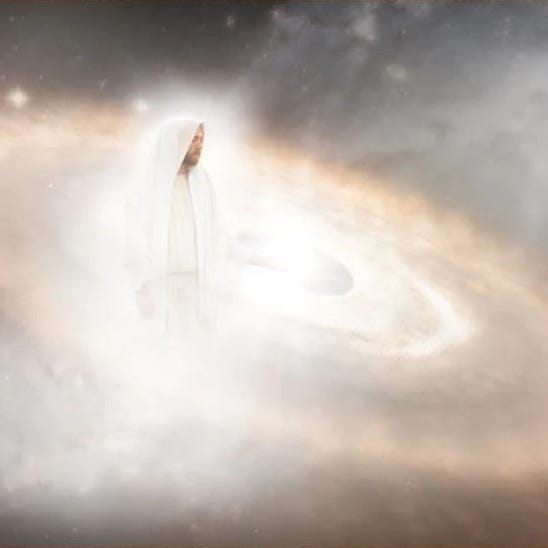
The seeds of apotheosis, when mankind becomes godkind. When a god has a child, is that child now a dog or snake? No, it is a god, or a godling at least.